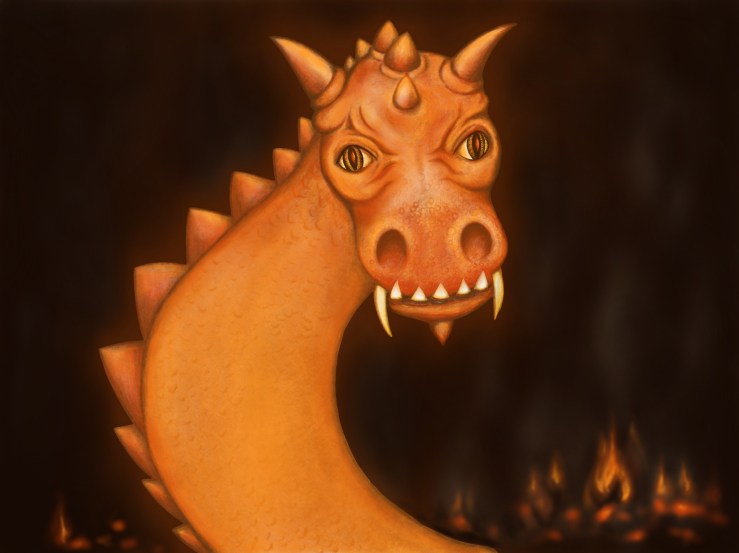
Teaching a Dinosaur New Tricks

IMG_0007
(Not a dinosaur)

I’m not afraid of technology, but I’ve never been an early adopter. I resisted digital cameras, digital music, and ebooks for what my techie friends would call an embarrassingly long time. It’s not that I don’t trust the digital versions of analog technology — I just like to have physical objects that I can hold in my hands. They seem more real: I feel more connected to them.

I’ve been especially reluctant, even by my standards, to experiment with digital illustration. Of all the things I’m willing to compromise on — ebooks are more portable, digital cameras more immediate, streaming music doesn’t clutter up my house — there’s something about creating art that just needs that connection between pencil and paper or paint and canvas. It’s just inherently physical to me.

But old-school paint-and-canvas art is also sloooooooow. More often than not when I get the urge to make something I either don’t have the time (like between work and picking the kids up from school) or can’t muster the energy (after the kids go to bed) for the whole set-up and clean-up. The prospect of portable art that can mimic a variety of analog media and be created in small chunks of time started to look more and more appealing.

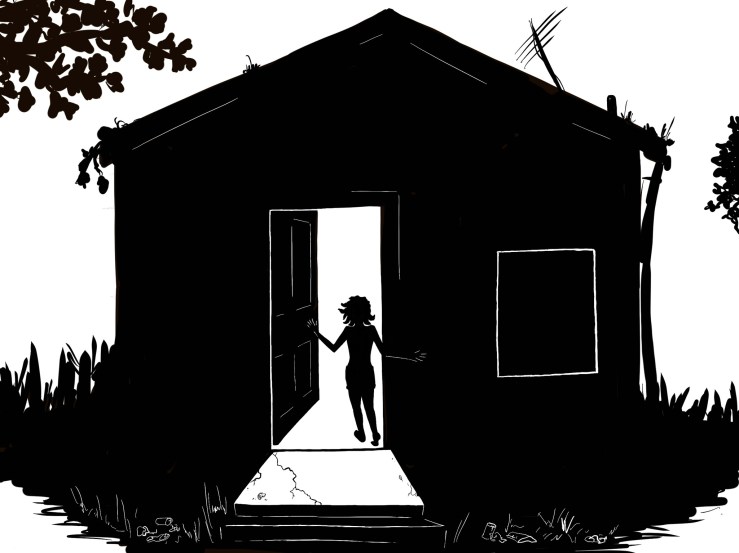
And then I played with the Apple Pencil and iPad Pro and I was smitten: So fast! So many options! So easy! Well, not that last part. While it’s incredibly easy to make dramatic changes to a piece in no time at all, making it look good is another story. Some tools don’t work at all the same as their analog counterparts. Drawing (see the goofy fire dragon up above) feels pretty similar. Drawing with digital pens/markers is weirder (but erasable!):
IMG_0006

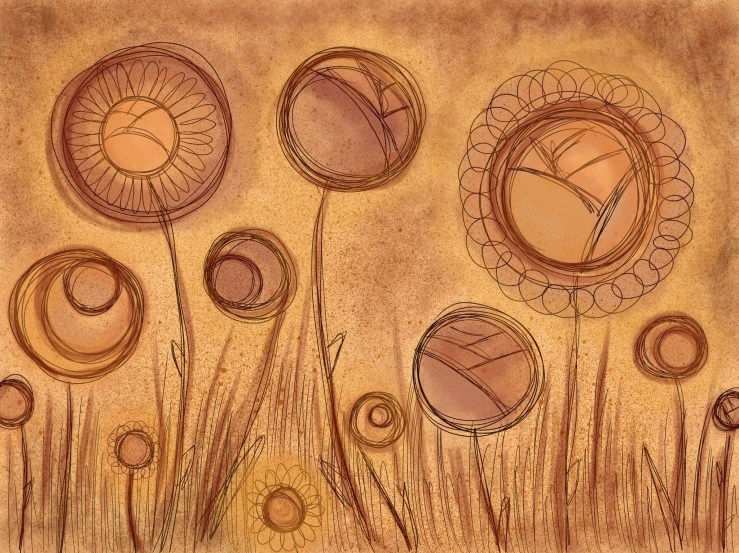
“Painting” with a digital pencil is nothing like actual painting. (I won’t subject you to an example because I still haven’t even worked out the basics.) Using a variety of textures and tools (like this drawing/painting/airbrushing/every-damn-thing-I-could-throw-at-it mess) is fun, if sloppy:
IMG_0004

And I’ve just started trying to manipulate photos, but it seems like it could be pretty satisfying:
IMG_0003

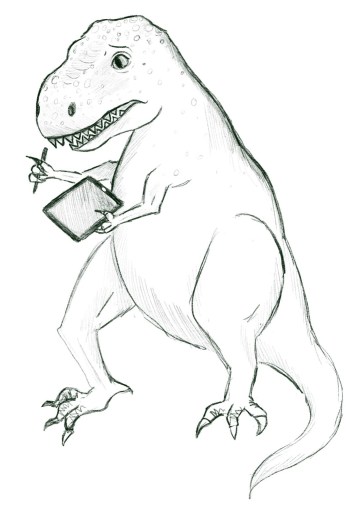
Once I get the hang of the tools I’m sure it’ll be easier, but now I feel like I’m re-learning skills I thought I’d at least had a basic knowledge of since elementary school. For now I’m just experimenting with the tools until I feel more comfortable. No doubt everyone who’s been using digital tools all along (which is probably pretty much everyone but me) finds all this easy, but I’m apparently a dinosaur. Specifically a T. rex with useless tiny arms that can’t hold the iPad properly.
IMG_0008

Shifting Gears

The problem with working quickly is that sometimes you get 85,000 words into a project before the second thoughts kick in. I knew from the beginning that the novel I started back in September was either the most marketable thing I’d ever written or a potential disaster. But I was having fun and clearly got a little carried away, writing nearly every day that the kids were at school — sometimes several thousand words per day. From late September through early February I wrote the bulk of the book, with just a handful of chapters remaining to tie some middle sections together. It was rough, dumped straight out of my brain to be harshly edited later, but it was going well.

Then the kids had a week off school and when I got back to writing I realized my momentum was gone. I’d already written the end of the book, which was probably a mistake — it’s hard to go back once the story feels like it’s been told. I stepped back and finally considered what I’d made, and the more I thought about it, the more I leaned toward “potential disaster.”

Luckily, around the same time I started talking with a friend about a children’s book he was working on and I felt inspired to return to a middle grade mystery I’d set aside a couple years ago. I jumped back in and six weeks later my first draft was done. Now it’s in the hands of test readers and I’m diving back into another abandoned project (an alternate history YA novel) for Camp NaNoWriMo — and hoping to use that autopilot speed-writing for something less disastrous!

It’s Like NaNoWriMo in September

Eight days of work, 20,000 words. I make no claims about this being a work of literary genius, but I’m pleased with my productivity. So far it’s mostly fragmented scenes without much structure, but I’m guessing the first draft will clock in around 100,000 words (and it’ll definitely shrink during editing). I’m not setting a daily word count goal, but if I can keep up this pace (not too likely) then a (very) rough draft could exist by Halloween! How fitting.

Okay, back to work…

Painting Progress

I’m working on what I think is an important step in making stuff for other people: stopping when they’re happy, rather than giving in to my tendency to keep messing with (and sometimes messing up) something until I like it.

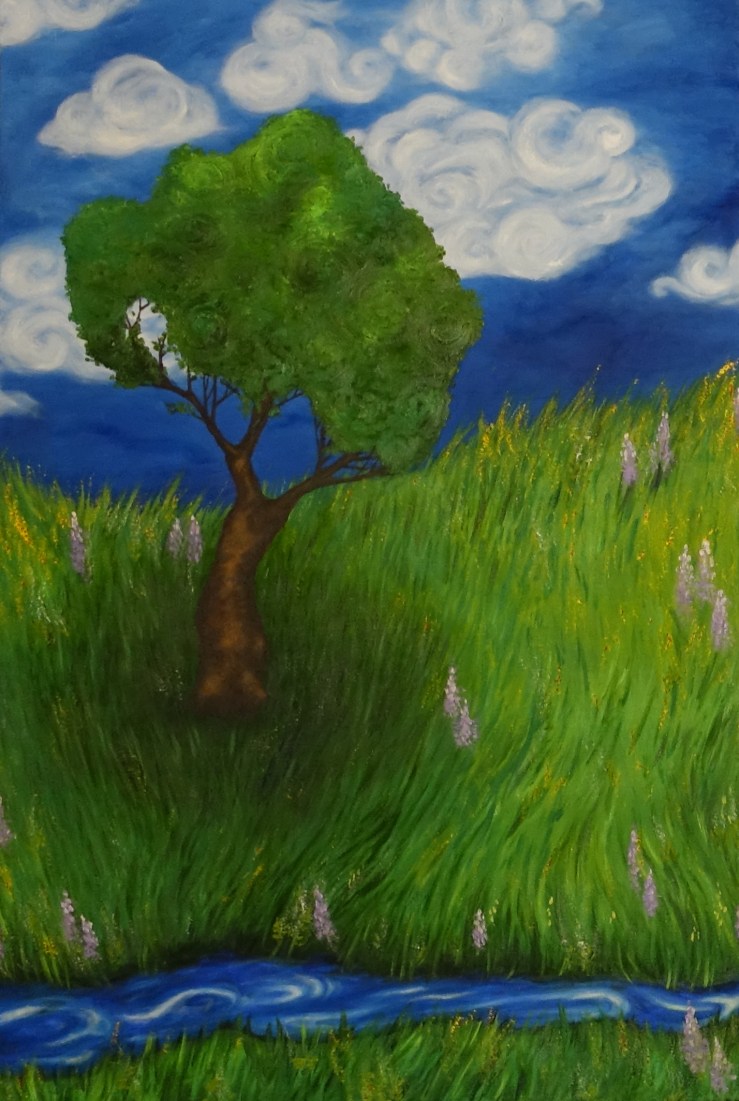
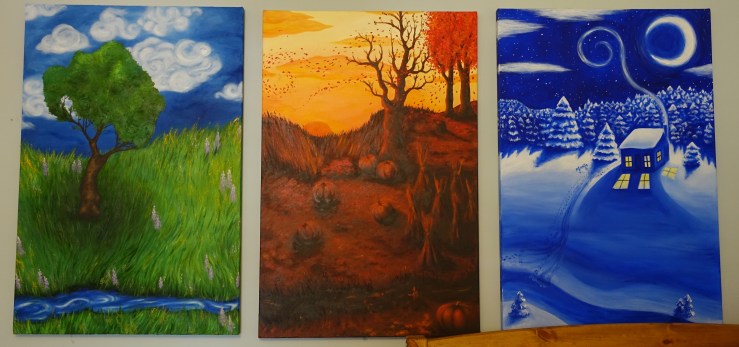
In this case, the third of the Seasons paintings for my kids. I’m not entirely happy with Summer (I like the top half, but I regret adding the wildflowers in the middle), but the kids said it’s done. So (deep breath) it’s done.

24052016-152-3

Here’s the (very badly hung) series so far in their room:

24052016-152-2

Next up, Spring. I’m slightly terrified of the sunrise-over-a-flowery-meadow palette…

Fresh Eyes

Over the last few months my writing time has been focused on novels (a work in progress and homework for class), but today I returned to the picture book that’s been *this* close to being finished for an embarrassingly long time. Fresh eyes and a change of pace did the trick. I chopped two more stanzas, bringing it down to a mere 20 (pretty reasonable for a 32-page book), and 849 words! I also managed to add a line where acrobats capture an evil clown with hula hoops. I must have been inspired by taking a circus class with my kids last week.

I may change my mind tomorrow, but at this moment I’m actually thinking I might be ready to start sending some queries. Of course, I’d absolutely love any last-minute test-readers. It only takes a few minutes to read — no novel-length commitment here! — and I’m not looking for line-by-line edits or anything. Any feedback at all is welcome. Any volunteers?

Snip, snip, snip

I did some editing on my too-long children’s book. Killed some darlings, as they say. It’s down to 934 words, which might still be too long, but hopefully won’t make agents or editors trash it just on the basis of word count without even reading it. I don’t think I cut anything too important to the plot — I have to remember that the illustrations will help tell the story.

stealingtheshowsketch2

(Not this illustration, mind you. This is my own VERY rough sketch of Ivan the knife-thrower and his assistant.)

My favorite line that didn’t make the cut:

The audience would never see, from over in the stands / The curtain cord betwixt the wicked trickster’s vicious hands.

(How often do you get to use the word “betwixt”? Not today for me, I guess…)

Reader Unlikely to Care About Little Miss Smug*

*Actual note from my writing teacher on my first chapter. (I’m just hoping he was talking about my narrator.)

Well, I had my first critique in my writing class today, and I survived, though I’m not sure my novel will — at least not in its current form. My classmates were mostly encouraging, but the teacher had a big problem with the voice of my narrator. I had worried that she might be unlikeable because she’s snarky and judgmental and more than a little bitter, but he was more concerned that writing it in her voice would alienate readers, that she was like being pinned down by an obnoxious person at a party who invades your personal space to rant at you. He’s got a point, though I admit I quite like listening to snarky people rant (when I can close the book/browser to shut them up). Being so inside her head makes it hard to see the rest of the characters or the world they’re in.

At least I’m only about 40 pages in, so rewriting now is better than having to rewrite a whole novel…

I’ve Got the Picture Book Word Count Blues

Woohoo! I’ve finished another revision of my current favorite children’s story, made some brutal edits to reduce the length, and when I read it aloud a few times, it sounded pretty good. I’m usually very critical of my own work, so when I get something to the point where I actually like it, I’m flying high. Hey, if I like it, this thing must be half-decent!

And then I started looking for agents to query. Wheeee! There goes the rollercoaster right back down again. First off, even among kidlit agents, there aren’t many who want picture books for older kids (the upper end of the PB market, that is: 4-7-year-olds). Of those, most don’t want rhyming books. And no one, anywhere, seems to want a book of more than 1,000 words – 400-600 seems to be what they’re looking for. Mine’s nearly 1,200, in rhyme, after serious editing. Damn.

Now, don’t get me wrong – I love a good minimalist picture book. Some stories, even for older kids, just don’t need a lot of text. “I Want My Hat Back” and “Don’t Let the Pigeon Drive the Bus!” are two current faves in our house, and they’re 253 and 161 respectively. Plenty of books that seem longer (but are still in the acceptable bedtime-story range) are 800-900, like the Octonauts books, the longer Julia Donaldson books, and plenty of fairytales.

Some classic children’s books have much, much higher word counts and can evoke a feeling of dread when bedtime is already being dragged out and the kid announces, “Let’s read Eloise!” I love Eloise, but at over 3,000 words it’s a bit much for sleepy parents. Same goes for “Dr. Seuss’s Sleep Book,” which at 1,700+ can put the entire family to sleep, including the person reading it from memory with their eyes closed. (Note that the four-year-old’s attention span is not a problem with these longer books – though she’s a little bookworm and we read lots of chapter books to her with no attention problems.)

But some of my very favorite (rhyming, no less!) books are above the desirable 600-word ceiling and definitely don’t feel too long for bedtime. “Bubble Trouble” is 832, “Iggy Peck, Architect” is 699, “The Pirate Cruncher” is 928. Maybe these are exceptions, but it seems to me that lots of favorite books in our household are in that general range. I’m not saying that my book is as good as those examples (and thus should also be an exception), just that there clearly is a market for books of that length, so it’s frustrating that agents/editors don’t want them. I know it’s about trends in publishing and shorter books are in favor right now, but I’m left feeling frustrated and disappointed that the book I really wanted to write, that I thought I wrote pretty well, probably doesn’t stand a chance.

I haven’t even sent a query letter and I’m already feeling rejected.

Doctor Tractor

My 18-month-old son is obsessed with tractors. Or maybe he’s obsessed with the word “tractor,” because he calls anything or anyone on wheels (including, embarrassingly, people in wheelchairs) “tractor.” He knows the words “car” and “bus” and “bike” and “train.” He just likes to call them tractors.

He also gets stuck in verbal ruts, as toddlers are wont to do. He’ll fixate on a word for ten minutes at a time, saying it over and over to the point where it becomes hilarious, then slightly irritating, then a droning background noise, then hilarious again. “Bubbles. Bubbles. Bubbles. Bubbles! BUBBLES! Bubbles. Bubbles.” And so on.

But when he gets going on “tractor” his pronunciation gets a little weird. It starts out as the normal version of “tractor,” then often shifts between “tracTOR!” and “tracta,” but sometimes it sounds very much like “doctor.” One day as he was saying “Tractor. Tractor! TracTOR! Tracta. Doctor. Tractor. Doctor. TracTOR!” and his sister and I couldn’t stop giggling at him, I decided I would write a book for him called Doctor Tractor. I started to work on it yesterday and I think I’ve figured out the story.

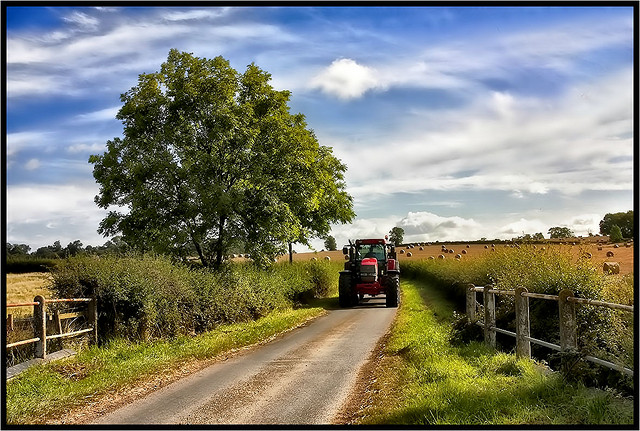
(Photo by Patrick Dalton)

Doctor Tractor is a country doctor who makes his house calls on an old tractor, hence the nickname (he’s a little James Herriot and a little like the old guy in The Straight Story). One day he gets a frantic call from a farmer who’s new to the area, saying “Loretta” needs help quickly. Doctor Tractor rushes over and discovers that Loretta is, in fact, a tractor. He explains to the confused farmer that he’s not a mechanic, but the farmer is too upset over Loretta to understand. But Doctor Tractor has good barnside manner and offers to take a look. Using his medical tools, he gives the tractor a check-up and somehow his first aid brings the tractor back to life — only she’s not just a tractor anymore.

What do you think of the premise? Too weird? Not weird enough?

Work in Progress Peepshow

Image
(Photo by Konstantin Lazorkin)

I’m in the middle of a manuscript-swap critique with another mystery writer, and while I’m looking forward to his feedback on my novel, I have to say I’ve really enjoyed the experience of reading his with a critical eye.

There’s a voyeuristic thrill reading a work-in-progress. You’re seeing someone’s imagination half-dressed, not quite ready to present itself to the world all dolled up and polished. It’s rough around the edges (and sometimes all the way through), maybe riddled with typos, and not entirely sure of itself. Tense and point-of-view are shifting, ephemeral. Characters haven’t quite found their voices. And that’s kind of cool.

I’m not speaking philosophically about the beauty of imperfection (though I do happen to think perfection is boring, aesthetically speaking), but literally about seeing the way another writer approaches the ideas of plot and character development and pacing. It’s like watching a house under construction, seeing all the framing and layers you take for granted when you walk through someone’s dining room, and the cool thing, especially when you’re reading a stranger’s work, is not even knowing what the house is actually going to look like when it’s completed.

I’m mixing my metaphors now. Probably should have put some stockings on those I-beams.