Runner-Up? I’ll Take It!

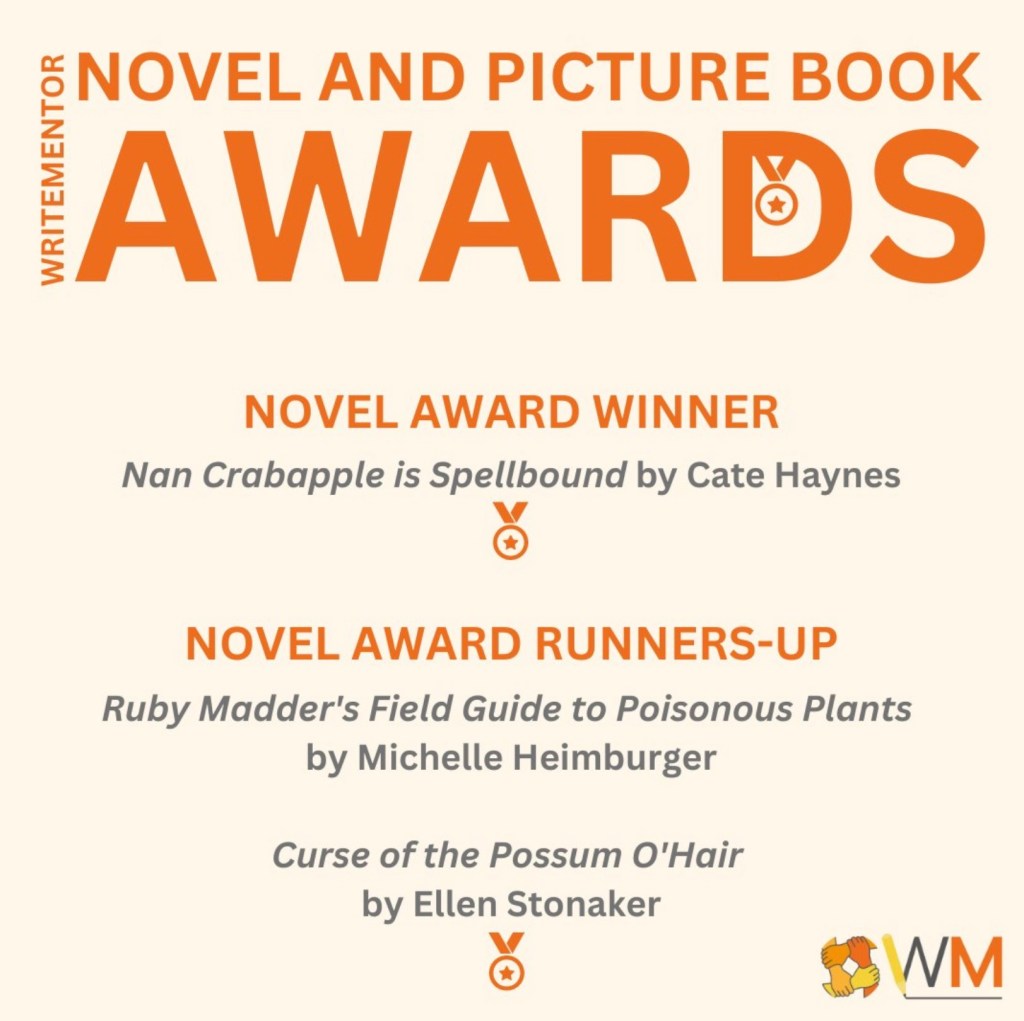
WriteMentor just announced their 2023 Novel and Picture Book Awards winners and I’m a runner-up! I am so excited — perhaps more than you might expect for not winning.

It can be so dispiriting trying to get your book out there. You’ve done your industry homework, developed your skills, learned from critique partners and classes and workshops. You’ve written (and edited and re-edited) a book you know is good. When you’ve finally got it all polished and pretty (complete with the dreaded synopsis and elevator pitch and comp titles and all that) you enter contests and send query letters to agents and then wait.

And wait.

And sometimes get polite rejections but never know why. There could be countless reasons — it’s not a good fit with that particular agent, they’ve got enough of your genre and age range already, the contest competition was just too good — but in the vacuum of what’s often a very solitary job, it’s impossible to keep the doubts at bay. No matter how confident you may be (at the best of times), you inevitably come back to wondering if all that silence and polite rejection is simply because the novel you’ve spent so many hours creating is just … not that good.

Or, slightly-better-than-worst-case scenario, the novel might be good but you’re so terrible at pitches and queries that no one will give it a shot. If only you could get someone to read the whole thing! Or tell you what’s not working. Or anything other than silence. It’s frustrating, and the more it gets you down, the harder it is to send the next round of queries or the next contest submission. You know deep down that that’s what it takes — just keep going, persistence pays off, everyone has setbacks — but whew. Some days that’s a lot easier said than done.

So this — this might be second place, it might not come with a cash prize or a contract, but it’s something. It means industry professionals — people who know a lot about the market and what readers like — not only actually read my book but saw something in it that they found worthwhile. If nothing else, that’s the reassurance my anxious mind needs to help me keep going for the next round of query letters … and the next book*.

*As soon as I decide which of the three books I’m working on will get my full attention…

Hey, Buddy — Can You Spare a Click?

My pitch for my latest novel, Ruby Madder’s Field Guide to Poisonous Plants, got picked for this year’s Nanowrimo Pitchapalooza. The winner of the popularity contest — er, public vote — gets an editorial consultation that would be super handy for someone like me who’s trying to break into the cutthroat kid-lit market. I’d be absolutely delighted if you could spare a minute to check out my pitch and vote for me if you think it’s good.

The pitch:

Two years ago her life was millionaires’ pool parties and posh private school. Now 15-year-old Ruby Bartek spends her free time helping with her divorced mom’s gardening business and updating her website, Ruby Madder’s Field Guide to Poisonous Plants, instead of having a social life. But her ticket back into her old world — a scholarship to the exclusive Sloane Academy — only makes things worse. Her classmates know all about the scandal that fractured Ruby’s family and uprooted them to the poor side of town. And Addie, Ruby’s former best friend, hasn’t just moved on: She’s skyrocketed up the social ladder with her new BFF, Sloane queen bee Taylor Hampton.

When Taylor is poisoned shortly after a very public argument with Ruby, rumors spread like dandelions in a suburban lawn. Ruby’s fascination with deadly toxins would be bad enough on its own, but her family’s history with the Hamptons — who had more than a little to do with the Barteks’ fall from grace — makes Ruby and her mom prime suspects. To clear her family and save any chance of ever putting down roots at Sloane, Ruby must find out what plant poisoned Taylor, and who — other than the Barteks — would have the knowledge and motive to use it.

RUBY MADDER’S FIELD GUIDE TO POISONOUS PLANTS, a 78,000-word contemporary YA mystery, is Veronica Mars meets Flavia de Luce in a wealthy Columbus, Ohio, suburb where toxic secrets lurk in impeccably landscaped yards and the most beautiful blooms hide the deadliest poisons.

And here’s where to vote (before 11:59 p.m. PDT on April 25, 2022): https://thebookdoctors.com/michelle-heimburger/

Thank you, kind voters!

A Flying Leap

I feel like every time I dip my toes into the waters of the publishing industry I get unceremoniously washed back to shore with my swimsuit full of sand and salt water up my nose before I even start swimming. Over and over again, I finish writing a book and actually think it’s pretty good: I’m confident! Excited! Ready to take the next step! So I start looking into the process of getting published — crafting the perfect query letter and synopsis, finding an agent vs. approaching publishers directly, identifying which ones might be a good fit — and then I sink like a stone.


Here’s what most industry sites seem to want writers to know:

  • Your novel is probably bad. Everyone has written one, and nearly everything that you first-time authors produce is amateurish and terrible. (Best case scenario: recycling bin. Worst case: subject of underpaid assistant editors’ gleeful mockery.)
  • Agents and publishers are swimming in manuscripts. No matter how good they are, virtually none of them will even be seen, let alone published.
  • To stand any chance at all, you must take as many classes as possible (an MFA in creative writing at the very least), join multiple critique groups, and hire an editor (or a few — you unpublished types probably need the extra help).
  • You have to win some awards. If you haven’t won anything no one will even look at your manuscript. (Unless you’re a celebrity. Are you a celebrity? No? Bad luck.)
  • You must read everything in your genre/market and be familiar with all recent and upcoming trends and titles. Your story must completely different and better than all of them.
  • You need an established online brand and a massive, devoted social media following. (If you’re not spending two hours a day on Twitter, you’re just not trying.)
  • It’s vital to attend conferences regularly and make as many industry contacts as possible, including but not limited to agents, publishers, editors, editorial assistants, and published authors with strong sales records.
  • You must have glowing personal references from top-tier agents or bestselling authors. (That should be easy since you’re now BFFs.)
  • Without these things you will not be published unless you’re the one-in-a-million fluke who’s miraculously written something amazing through some sort of cosmic serendipity or divine intervention and also the stars happen to align perfectly. (But you’re not, you haven’t and they won’t.)


Whew. So I brush the sand out of my eyes and start thinking how I’d better get to work on all of that stuff first, before I even consider inflicting my work on anyone else. Sure thing. Easy peasy. Only … I’d rather be, you know, writing. All of that research, online schmoozing and author-stalking takes way more time (and possibly superhuman abilities) than I have. It sounds exhausting. And I’m sure that’s the point: Weed out the easily scared before they even have a chance to add to the industry’s workload.

At this point I often have a terrible thought — a glimmer of not-quite-dead-yet confidence — that maybe those things don’t all apply to me. Of course agents get inundated with terrible submissions from people who haven’t even bothered to proofread and haven’t read enough books to know the basics of storytelling (or the basics of grammar). Except those people are probably having the exact same thought, which means … oh no, I’m one of them! I’ve written a terrible book and can’t even see how bad it is. That’s proof that it’s terrible!

After that I’m ready to just bury my manuscript and move on. The problem is that I keep getting hung up at that stage. Finish book, get excited, do research, despair. I don’t even get to the stage where I actually send things out to get rejected for real — I’m self-rejecting before the professionals have a chance to do it. It’s not that I’m afraid of rejection so much as I’m so sure of it that I just cut out the middleman.

After several times through this cycle, though, I might finally break it. My endlessly patient husband stopped me at the beginning of the Despair phase this time, very reasonably pointing out that this isn’t my first novel, I have taken classes and done critiques, I have done market research, and I’ve already made revisions based on feedback from readers. He also calmly reassured me that test readers have busy lives and there are plenty of reasons why someone might ask to read my manuscript and then never mention it again (reasons beyond my theory that they did read it, but they hated it so much that they can’t even bring themselves to tell me they hated it). And he reminded me that the test readers I have heard from said nice things and gave helpful feedback. Maybe, he suggested, I should trust the positive responses for once and stop assuming that silence is negative.

So I know I’m never going to have two hours a day to spend on Twitter and I have no interest in schmoozing strangers simply for the sake of making industry contacts. But I’ve put a lot of work into this book (and all the ones that came before) and each one benefits from the lessons I learned on the last. It probably will get rejected, because most submissions do, but that’s no reason not to give it a shot. Maybe it’s time to stop worrying about getting every possible thing perfect according to someone else’s standards and, to return to my lame ocean metaphor, just dive in…

Shifting Gears

The problem with working quickly is that sometimes you get 85,000 words into a project before the second thoughts kick in. I knew from the beginning that the novel I started back in September was either the most marketable thing I’d ever written or a potential disaster. But I was having fun and clearly got a little carried away, writing nearly every day that the kids were at school — sometimes several thousand words per day. From late September through early February I wrote the bulk of the book, with just a handful of chapters remaining to tie some middle sections together. It was rough, dumped straight out of my brain to be harshly edited later, but it was going well.

Then the kids had a week off school and when I got back to writing I realized my momentum was gone. I’d already written the end of the book, which was probably a mistake — it’s hard to go back once the story feels like it’s been told. I stepped back and finally considered what I’d made, and the more I thought about it, the more I leaned toward “potential disaster.”

Luckily, around the same time I started talking with a friend about a children’s book he was working on and I felt inspired to return to a middle grade mystery I’d set aside a couple years ago. I jumped back in and six weeks later my first draft was done. Now it’s in the hands of test readers and I’m diving back into another abandoned project (an alternate history YA novel) for Camp NaNoWriMo — and hoping to use that autopilot speed-writing for something less disastrous!

My Own Worst Editor

I’ve always had a wordiness problem. When other high-schoolers were lamenting 500-word essays, I was thinking “500 words? That’s just my prologue!” My college thesis was roughly 40 pages longer than necessary (and surely even my advisors didn’t make it to the end because it was a massive heap of pretentious gibberish). I may also enjoy a liberal sprinkling of superfluous adjectives.

Yet somehow, hilariously, I’ve spent the last 22 months working as a copyeditor for a daily news briefing, a task which requires tightening up text from (already alarmingly short) paragraphs. And it’s fine — it’s not like I’m not able to be succinct. In fact, I was slightly surprised to discover I’m pretty good at that element of the job: Take a paragraph, somewhere in the ballpark of 106 words, telling the key facts of a story. Check for grammatical errors and style guide compliance. Fact check. Improve the flow. Prune unnecessary words. Revise to eliminate even more words to get it down to 95. Check it all again. Move on to the next. It’s fun … if you’re a big nerd like me.

The really surprising thing, though, is that this newfound succinctness is leaking into my other writing. (And if you’re thinking “Really?” based on this rambling, I can assure you that yes, two years ago this would have been even ramblier.) One example: The epic rhyming picture book that started at an utterly unpublishable 1,719 words — the one I congratulated myself on trimming down under 1,200 a few years ago? It’s now 757.

The only problem is that now when I return to a project I spend more time pruning than writing. So I’ve decided to use this newfound talent for dismantling my previous work to take another pass at my first novel, the “practice novel.” It’s got some plot problems I’ll also need to deal with along the way, but I’m curious how much I can tighten it up. I’ve just started, but I’ve already chopped the first chapter from 2,013 words to 1,864.

It’s strange to think of writing as a subtractive process.

Confessions of Defeat

I can’t believe it’s been a year since I posted here… only… well, no, that’s not really true. I’m not surprised, actually. In the last year, other than being busy with the usual things like family, work, and all of the standard daily-life stuff that always gets in the way of creativity, I’ve been facing a crisis of confidence.

I’ve been reluctant to talk about it. Who wants to admit defeat? Who wants to express wavering self-confidence, especially in an industry that values self-promotion, perseverance and flawless self-certainty above nearly everything else? I’ve almost written this post so many times, but held myself back. Am I dooming myself by admitting I’ve felt discouraged? Am I closing future doors by confessing to periods of low self-esteem? Perhaps.

But I don’t think I’m exactly alone. Creative work is an irrational manic roller coaster of I-will-conquer-the-world! enthusiasm and why-did-I-ever-think-I-could-do-this? doubts. You spend so much time and energy alone in your head, with only your characters and ideas for company. You’re hard on yourself, doubting and revising and improving and doubting again, until you finally whittle down the doubts enough that you can see past them. You psych yourself up, actually get excited because you’ve finally created something that you really genuinely like — and maybe someone else will like it, too. In a delirious rush you go for it. You hit Send. You let someone look over your shoulder at the screen. You hand the pages to test readers. Your creation is officially out of your head and into the world, even if only one other person sees it, because creative work only exists in the binary states of Your Head or The Whole World.

And that’s where it gets scary, because now someone else is looking at your baby, this weird and flawed beast that, unlike a real baby, you can’t even blame on previous generations’ bad genes. You can only blame the content of your own head and the abilities of your own hands. Now it’s out there and it’s too late to take it back and now you’re being judged — not just your creation, but your whole self being judged — on what you’ve willed into form.

Oh hell.

You wait. Holding your breath. Twitchy with adrenaline. And sometimes you get what you need: Approval, acceptance, the relief that you did actually make something worthwhile. Sometimes you get disappointing-but-useful constructive criticism, which might sting, but shows that someone cared enough to try to help, that they saw enough potential to be worth improving.

And sometimes… oh, this one’s the killer. Sometimes you get “Nice” or “Yeah, it’s pretty good,” and a quick change of subject. Ouch. So it’s not nice, not good, it’s unfixable or uninteresting or just so terribly, terribly useless that we can’t even talk about it. Let’s move on.

Only you can’t, of course, especially when the damning indifference comes from someone who cares about you or someone who’s usually supportive or someone who’s more experienced and knowledgeable than you are. Then you really can’t move on, because the only movement you can imagine is crawling into a cave, possibly carrying everything you’ve ever created to burn for warmth while you hibernate away from everyone you’ve just humiliated yourself in front of… which obviously is now The Whole World.

And of course it’s unfair — it’s unfair to that kind, supportive person who usually has time for constructive critique/ego-stroking, who may have just been busy or having a bad day or needed some time to get their thoughts together. It’s unfair to that critique partner or teacher or agent who is, in reality, considering a piece of creative work and not actually judging your value as a human being. None of those people are actually The Whole World and they never claimed to be. It’s unfair to hang the full weight of your creative self-worth on someone else.

But it’s also impossible to stop yourself feeling that blow that knocks your legs right out from under you.

So (obviously) I had one of those experiences last year. A small series of them: A curt reaction to a half-finished story that I thought was going well, a form-letter rejection of a picture book I actually believed was pretty good, and a short-but-not-sweet no-constructive-criticism judgment (of the same book) from the teachers of a class that I’d previously thought I was doing well in. Strike three. I was humiliated. I felt like I’d probably been embarrassing myself all along, every time I’d ever shared anything that I’d created. The Whole World knew it sucked, but I was only just figuring it out. Yikes.

The roller coaster careened downward. I tried to take a break from writing. It didn’t make me feel any better. In fact, it just depressed me more. Finally I resumed writing, only because I wanted needed to, just for myself, and not with any idea of ever showing it to anyone ever again. Ever. Ever ever ever.

I wrote more. I felt better. I feel better. The train is click-click-clicking back up the hill.

I hope to post more soon. I will post more soon.
Fresh Eyes

Over the last few months my writing time has been focused on novels (a work in progress and homework for class), but today I returned to the picture book that’s been *this* close to being finished for an embarrassingly long time. Fresh eyes and a change of pace did the trick. I chopped two more stanzas, bringing it down to a mere 20 (pretty reasonable for a 32-page book), and 849 words! I also managed to add a line where acrobats capture an evil clown with hula hoops. I must have been inspired by taking a circus class with my kids last week.

I may change my mind tomorrow, but at this moment I’m actually thinking I might be ready to start sending some queries. Of course, I’d absolutely love any last-minute test-readers. It only takes a few minutes to read — no novel-length commitment here! — and I’m not looking for line-by-line edits or anything. Any feedback at all is welcome. Any volunteers?

Snip, snip, snip

I did some editing on my too-long children’s book. Killed some darlings, as they say. It’s down to 934 words, which might still be too long, but hopefully won’t make agents or editors trash it just on the basis of word count without even reading it. I don’t think I cut anything too important to the plot — I have to remember that the illustrations will help tell the story.

stealingtheshowsketch2

(Not this illustration, mind you. This is my own VERY rough sketch of Ivan the knife-thrower and his assistant.)

My favorite line that didn’t make the cut:

The audience would never see, from over in the stands / The curtain cord betwixt the wicked trickster’s vicious hands.

(How often do you get to use the word “betwixt”? Not today for me, I guess…)

I’ve Got the Picture Book Word Count Blues

Woohoo! I’ve finished another revision of my current favorite children’s story, made some brutal edits to reduce the length, and when I read it aloud a few times, it sounded pretty good. I’m usually very critical of my own work, so when I get something to the point where I actually like it, I’m flying high. Hey, if I like it, this thing must be half-decent!

And then I started looking for agents to query. Wheeee! There goes the rollercoaster right back down again. First off, even among kidlit agents, there aren’t many who want picture books for older kids (the upper end of the PB market, that is: 4-7-year-olds). Of those, most don’t want rhyming books. And no one, anywhere, seems to want a book of more than 1,000 words – 400-600 seems to be what they’re looking for. Mine’s nearly 1,200, in rhyme, after serious editing. Damn.

Now, don’t get me wrong – I love a good minimalist picture book. Some stories, even for older kids, just don’t need a lot of text. “I Want My Hat Back” and “Don’t Let the Pigeon Drive the Bus!” are two current faves in our house, and they’re 253 and 161 respectively. Plenty of books that seem longer (but are still in the acceptable bedtime-story range) are 800-900, like the Octonauts books, the longer Julia Donaldson books, and plenty of fairytales.

Some classic children’s books have much, much higher word counts and can evoke a feeling of dread when bedtime is already being dragged out and the kid announces, “Let’s read Eloise!” I love Eloise, but at over 3,000 words it’s a bit much for sleepy parents. Same goes for “Dr. Seuss’s Sleep Book,” which at 1,700+ can put the entire family to sleep, including the person reading it from memory with their eyes closed. (Note that the four-year-old’s attention span is not a problem with these longer books – though she’s a little bookworm and we read lots of chapter books to her with no attention problems.)

But some of my very favorite (rhyming, no less!) books are above the desirable 600-word ceiling and definitely don’t feel too long for bedtime. “Bubble Trouble” is 832, “Iggy Peck, Architect” is 699, “The Pirate Cruncher” is 928. Maybe these are exceptions, but it seems to me that lots of favorite books in our household are in that general range. I’m not saying that my book is as good as those examples (and thus should also be an exception), just that there clearly is a market for books of that length, so it’s frustrating that agents/editors don’t want them. I know it’s about trends in publishing and shorter books are in favor right now, but I’m left feeling frustrated and disappointed that the book I really wanted to write, that I thought I wrote pretty well, probably doesn’t stand a chance.

I haven’t even sent a query letter and I’m already feeling rejected.

Doctor Tractor

My 18-month-old son is obsessed with tractors. Or maybe he’s obsessed with the word “tractor,” because he calls anything or anyone on wheels (including, embarrassingly, people in wheelchairs) “tractor.” He knows the words “car” and “bus” and “bike” and “train.” He just likes to call them tractors.

He also gets stuck in verbal ruts, as toddlers are wont to do. He’ll fixate on a word for ten minutes at a time, saying it over and over to the point where it becomes hilarious, then slightly irritating, then a droning background noise, then hilarious again. “Bubbles. Bubbles. Bubbles. Bubbles! BUBBLES! Bubbles. Bubbles.” And so on.

But when he gets going on “tractor” his pronunciation gets a little weird. It starts out as the normal version of “tractor,” then often shifts between “tracTOR!” and “tracta,” but sometimes it sounds very much like “doctor.” One day as he was saying “Tractor. Tractor! TracTOR! Tracta. Doctor. Tractor. Doctor. TracTOR!” and his sister and I couldn’t stop giggling at him, I decided I would write a book for him called Doctor Tractor. I started to work on it yesterday and I think I’ve figured out the story.

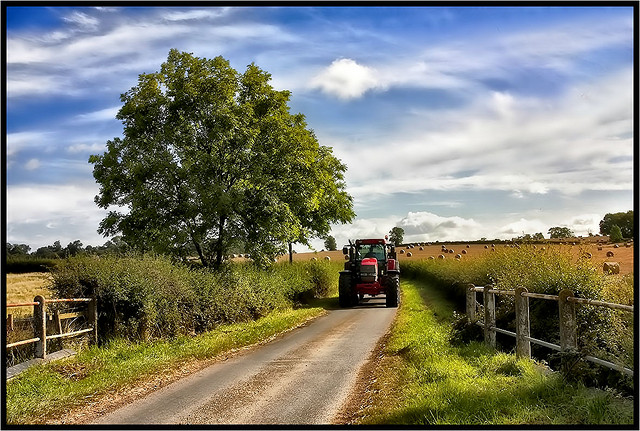
(Photo by Patrick Dalton)

Doctor Tractor is a country doctor who makes his house calls on an old tractor, hence the nickname (he’s a little James Herriot and a little like the old guy in The Straight Story). One day he gets a frantic call from a farmer who’s new to the area, saying “Loretta” needs help quickly. Doctor Tractor rushes over and discovers that Loretta is, in fact, a tractor. He explains to the confused farmer that he’s not a mechanic, but the farmer is too upset over Loretta to understand. But Doctor Tractor has good barnside manner and offers to take a look. Using his medical tools, he gives the tractor a check-up and somehow his first aid brings the tractor back to life — only she’s not just a tractor anymore.

What do you think of the premise? Too weird? Not weird enough?